
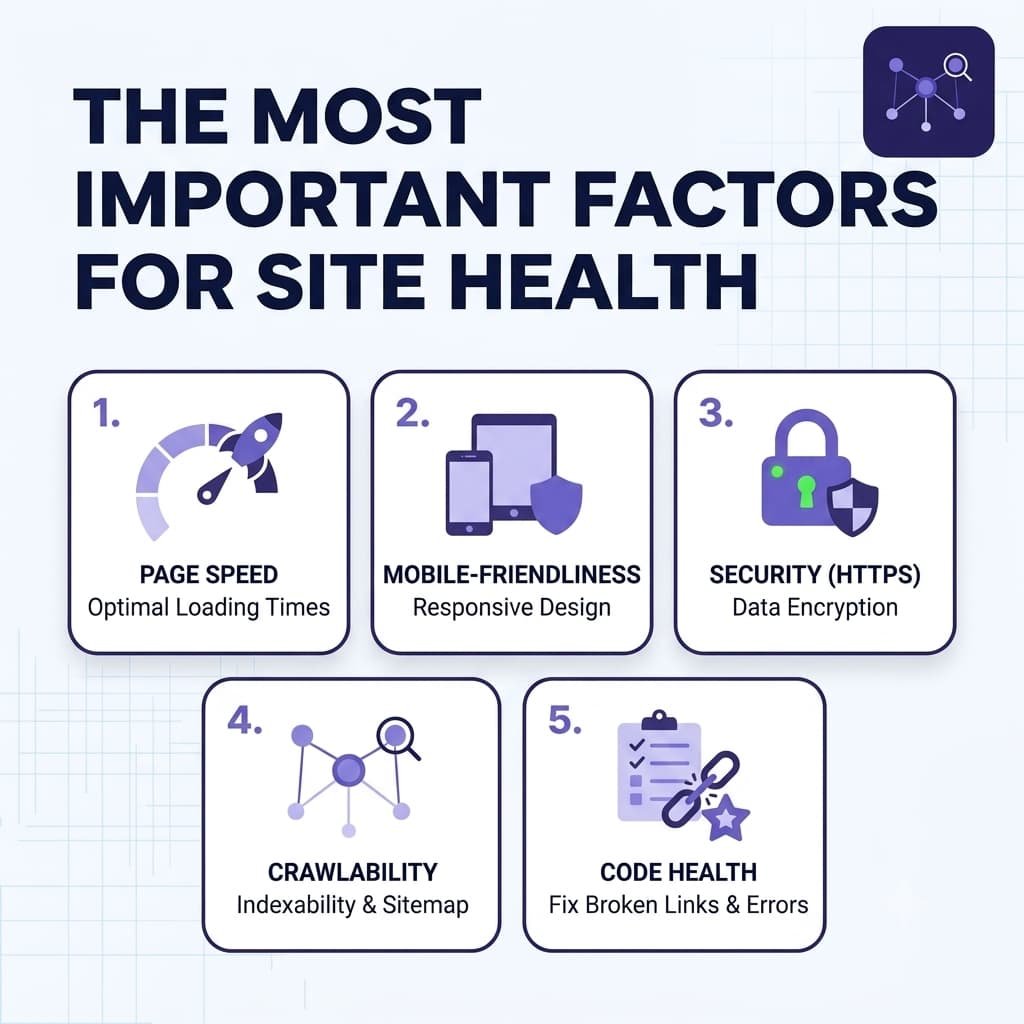
The Most Important Factors for Site Health (And How to Check Each One)
The core factors that define a healthy website — crawlability, indexation, response integrity, metadata, content quality signals, internal architecture, performance, security and structured data.
Updated September 2026
From issue to evidence
Issues and affected URLs
Open Technical issues, choose Critical, Moderate or Low priority, search a URL or title, then choose an issue. The Affected URLs subtab shows matching pages and resources with response details. Switch back to Issues to choose the next fix.
Health that reflects impact
Priorities include robots access, 5xx responses, 404s, redirect chains, insecure links and broken scripts or stylesheets. Scores use observed impact and crawl coverage. They are technical audit indicators, not Google ranking scores.
Your sites and their history
Guests can crawl. Sign in to manage multiple websites and save their reports. Choose once, daily, weekly or monthly. Summary history tracks scores and issue counts; monthly archives preserve detailed reports when a crawl completes. Repeat schedules require the service to be running.
AI when you choose it
Open AI Connections, choose OpenAI, Gemini, Claude or an OpenAI-compatible API, enter a text model ID and API key, then Test & connect. AI Summary appears after connection. You can also copy an aggregate audit brief into any AI app without an API connection.
Measured performance
Review slow responses, large resources, compression and mixed content across HTML, images, JavaScript, CSS, PDF and other files. Use PageSpeed for browser diagnostics and available field data for Core Web Vitals.
Reports and connected metrics
Connect your own Search Console and GA4 properties to show their reporting data. Export a PDF action plan or filtered CSV. Saved reports and connections remain scoped to your account.
Technical health in Looker Studio
After a crawl is saved, open Looker Studio in the sidebar and create your read-only score and error key. Open the connector, authorise it with that key, choose one website and add a scorecard using Technical health score. Choose Site summary for the latest technical score and issue counts. Add a second source using Issue breakdown for issue names, priorities and affected-page counts. Page URLs and Google reporting metrics are not shared. Refresh the source after a new saved crawl. Replace or revoke your key from the same screen.
'Site health' gets used loosely, but it decomposes into a specific set of measurable factors. Here are the ones that matter most, why each one affects rankings, and how to check it.
1. Crawlability & Indexability
If bots can't fetch a page (robots.txt blocks, server errors) or aren't allowed to index it (noindex, bad canonicals), that page doesn't exist to search. This is the first factor to verify on any site — and in the AI era, it includes whether AI crawlers are permitted, not just classic search bots.
2. Response Integrity
Every URL — pages and assets — should return the status it's supposed to. Broken pages (4xx/5xx) waste crawl budget and destroy user trust; broken scripts, styles and images silently degrade pages that look 'fine' in reports. Always audit assets with their status codes, not just HTML pages.
3. Metadata Quality
Unique, well-sized titles and meta descriptions per page. Duplication is the classic large-site disease: templates generating identical titles across dozens of pages force search engines to guess which one to rank — and usually the answer is none of them well.
4. Heading Structure & Content Signals
One clear H1 per page, a logical H2–H6 hierarchy, sufficient word count for the topic, and a healthy text-to-HTML ratio. Pages that are mostly markup with little text struggle to establish relevance.
5. Internal Architecture
How pages link to each other decides how authority and crawl attention flow. Key measures: crawl depth (important pages within ~3 clicks of home), no orphan pages, descriptive anchor texts, and a sitemap that matches reality. A site's depth distribution chart tells this story at a glance.
6. Performance
Speed is both a ranking signal and a conversion factor. The technical culprits are consistent: render-blocking resources, oversized and unused JavaScript, heavy images, and long main-thread tasks. Fixing these improves Core Web Vitals and every user metric downstream.
7. Security & Protocol Coverage
Full HTTPS with valid certificates on every node — mixed content and unverified nodes undermine both trust and rankings. Aim for 100% SSL/TLS coverage across pages and assets.
8. Structured Data
Valid schema markup (Organization, WebSite, BreadcrumbList, Article and friends) helps search engines and AI systems understand your entities and unlocks rich results. Error-free JSON-LD across templates is now table stakes for competitive niches.
Alpha Crawler checks all eight factors in a single free crawl of up to 10,000 pages — and every report exports to CSV for your team. Need a hand or auditing at agency scale? Contact us at support@alphacrawler.org.
Run a Free Technical Audit of Your Site
Up to 10,000 pages. Every diagnostic. CSV & PDF exports. Free.
support@alphacrawler.org · LinkedIn